
Carteret County Arrest Records
Carteret County arrest records are tied to the arrest, booking, and law-enforcement side of a criminal matter. They may involve the Sheriff's Office, a municipal police agency, the detention center, or another arresting agency. Court charge records are different. They are the formal accusations filed in the court system and tracked by the Clerk of Superior Court after the case opens.
The Sheriff's Office and detention center handle custody information, arrest-related records, and jail records. The Clerk of Superior Court handles court charges and the case file. The District Attorney decides and prosecutes state criminal charges in Prosecutorial District 4. For booking or current custody information, the jail channel is the better route. For the full case outcome, use Carteret County criminal court records.
The Carteret County Sheriff's Office page is the local law-enforcement source connected to arrest records and related public-safety records.
That Sheriff's Office channel is separate from eCourts because law-enforcement records and filed court charges have different custodians.
Find Arrests and Charges
The first choice depends on the question. For a current inmate or jail booking issue, use the Carteret inmate inquiry and detention center contact route. For court charges after arrest, use the North Carolina eCourts Portal Smart Search and select Carteret County. For a pending court date, use Search Hearings. For a certified copy or older paper file, contact the Clerk of Superior Court Criminal Division.
- For custody status, check the Carteret inmate channel or call the detention inquiry line for discrepancies.
- For filed charges, open eCourts Smart Search and search by defendant name or case number.
- Use Carteret County as the location filter so the search does not pull unrelated statewide matches.
- Read each charge separately because counts can be amended, reduced, dismissed, or resolved in different ways.
- Call the Criminal Division, Sheriff's Office, or District Attorney only for the record type each office controls.
The Carteret County public-records request routing page says court records and dates go to the Clerk of Court, while law-enforcement records go to the Sheriff's Office records unit or the related agency. That routing rule is useful for arrest records because a case can have both a jail or agency record and a separate court charge record.
Carteret Booking Records
The Carteret County Detention Center, also called CCDC, is operated by the Sheriff's Office at 304 Craven Street in Beaufort. The official detention page says the facility is responsible for the care, control, and custody of Carteret County inmates and the safety of staff and visitors. No inmate is held except by court order or other lawful authority. The detention center phone is 252-728-8400, and the inmate inquiry questions line is 252-504-4832.
The Carteret Detention Center page is the local source for custody context connected to Carteret County arrest records.
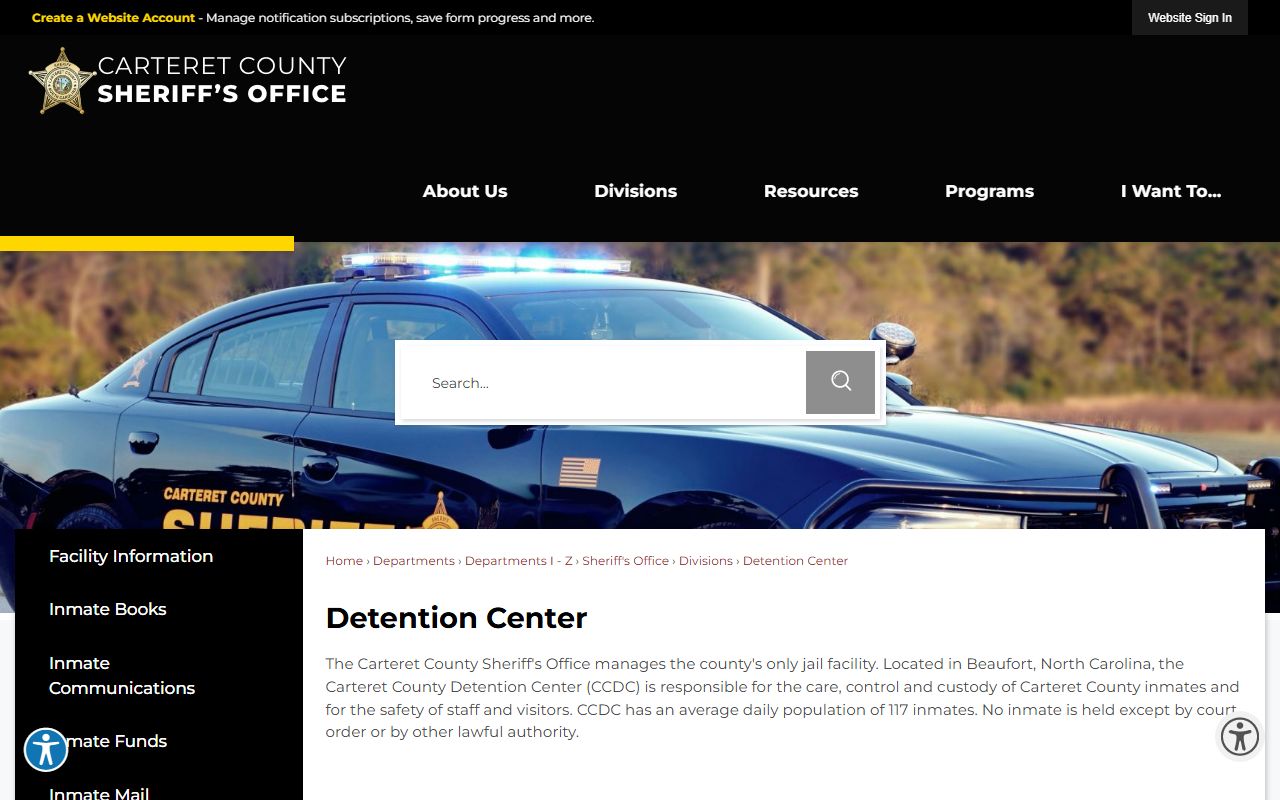
Detention information helps explain the arrest side, but filed charges and dispositions still belong in the court record.
The official inmate-search disclaimer says current inmate information is provided for public use, may be incomplete until fingerprint or criminal-history verification is complete, and does not imply guilt or wrongdoing. That warning carries over to arrest records. A booking entry is not a conviction. It may be followed by a filed charge, a dismissed charge, no charge, or a later court outcome.
Carteret Charging Documents
Court charges after arrest start with a charging document. North Carolina criminal cases can involve warrants, citations, criminal process, informations, indictments, and other filings depending on the offense and court path. The table below keeps the required concepts distinct. Carteret users should read the actual case entry because the label used in the record controls the filed charge.
| Document | Who Uses It | Common Role | Record Effect |
|---|---|---|---|
| Complaint or warrant-related filing | Law enforcement, magistrate, or prosecutor depending on process | Begins or supports an accusation after arrest or probable cause review. | May create the first court charge entry and bond or release context. |
| Information | Prosecutor | Formal prosecution document used in some criminal matters. | Sets out the offense, count, and prosecution theory in court. |
| Indictment | Grand jury through the prosecutor | Moves many felony matters into Superior Court. | Creates or replaces the superior-court charging basis for felony prosecution. |
Carteret Charge Status
Charge status changes as a criminal case moves through District Court and Superior Court. One arrest can produce more than one charge, and each charge may follow a different path. A case can show a serious initial allegation that is later reduced, a dismissed count beside a conviction on another count, or a failure-to-appear event that affects release conditions.
| Status | What It Means | Where It May Appear |
|---|---|---|
| Pending | The accusation is active and no final outcome has been entered. | Smart Search, docket events, Search Hearings. |
| Amended | The charge wording, count, offense, or legal basis changed. | Case docket and charge list. |
| Reduced | The prosecution or court record reflects a lesser offense or level. | Disposition, plea, or amended charge entry. |
| Dismissed | The charge ended without a conviction on that count. | Disposition or docket event. |
| Convicted | The charge resulted in a guilty plea, verdict, or judgment of guilt. | Disposition, judgment, sentence, and financial fields. |
| Expunged | An eligible public entry was cleared after an expunction order. | May no longer appear in public court records. |
Charge vs Conviction
Arrest records and court charges can be misunderstood if the final outcome is ignored. A charge is not a finding of guilt. It is the accusation that begins or moves a prosecution. A conviction is a court outcome after a guilty plea, verdict, or other judgment. Carteret County court charges should be checked through final disposition and sentence fields before any conclusion is drawn.
| Point | Charge | Conviction |
|---|---|---|
| Meaning | Filed accusation after arrest, citation, warrant, information, or indictment. | Final guilt finding or judgment on a charge. |
| Timing | Appears early and may change. | Appears after plea, verdict, or judgment. |
| Possible result | Pending, amended, reduced, dismissed, or tried. | Sentence, probation, fines, costs, restitution, or appeal. |
| Record caution | Does not prove guilt. | May still be subject to appeal, correction, or expunction if eligible. |
DA and Charge Filing
The District Attorney prosecutes state criminal matters in Carteret County. The official Judicial Branch news release says Prosecutorial District 4 serves Carteret, Craven, and Pamlico counties, and Matthew T. Wareham was appointed District Attorney in 2025. The DA may prepare criminal trial dockets, advise law enforcement, and supervise prosecution staff. That office is part of the charging process, but it is not the public custodian for the clerk's case file.
The Public Defender may be involved when a defendant qualifies for appointed counsel. IDS lists Carteret Defender District 4 and the Public Defender Office at 252-504-4545. Defense counsel, prosecution, law enforcement, and the clerk all touch the criminal process, but each office owns a different part of the information trail.
The North Carolina Sheriffs' Association Carteret listing is a current-status law-enforcement reference connected to Carteret County arrest records.
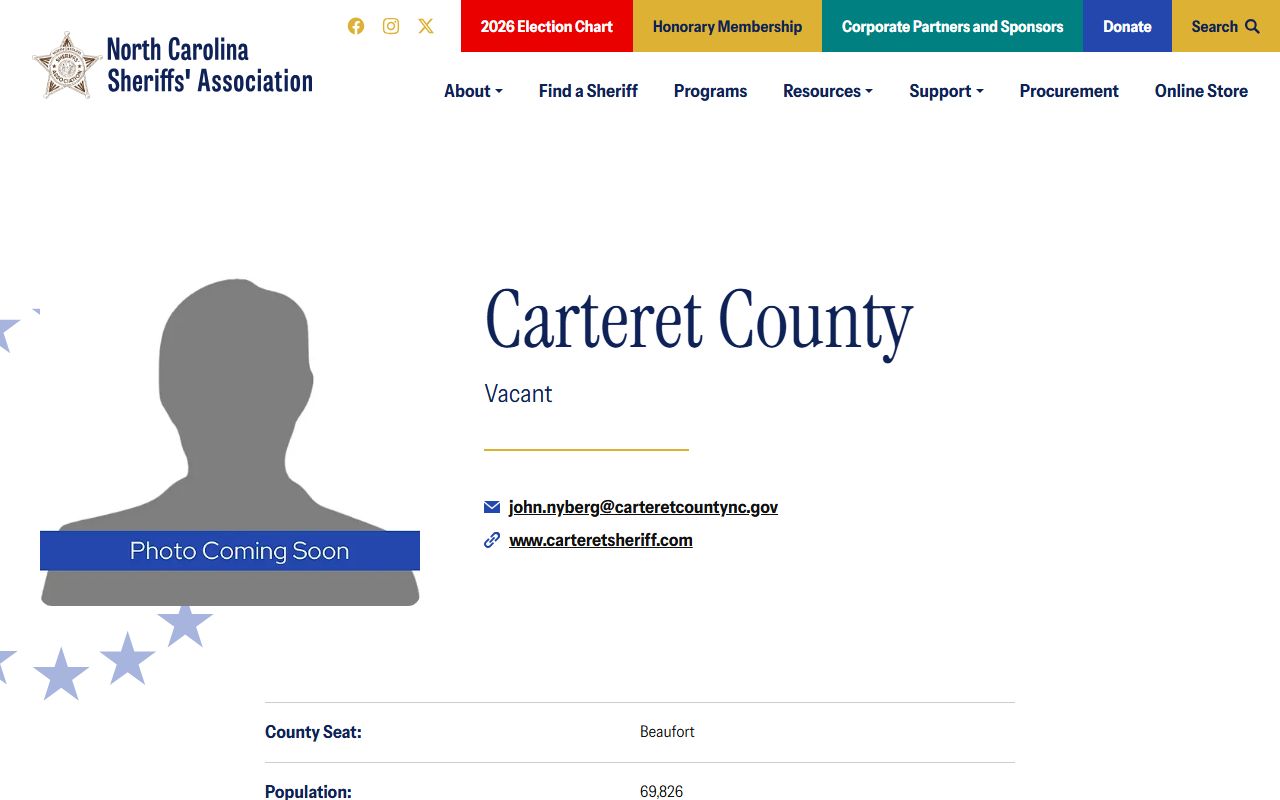
The listing is useful because research found a sheriff transition note, so current law-enforcement status should be checked before naming an individual sheriff.
Statewide Criminal Lookups
Statewide systems can supplement, but not replace, Carteret arrest records and court charge records. NC DAC searches state prison offenders, probationers, and parolees, and it does not include county jail information. NC VINE provides custody-status and criminal-case notification. The North Carolina Sex Offender Registry is maintained by the SBI, while Carteret Sheriff's Office handles in-person local sex-offender registration.
The Sheriff's mobile app is another public-safety channel. Official sources describe the Carteret County Sheriff app as a way to report crimes, submit tips, receive news, and communicate with the Sheriff's Office. The research did not confirm an app-only warrant or inmate lookup, so the app should not be treated as the primary arrest-record search tool.
Sealed or Expunged Charges
Some arrest records and court charges are restricted. Juvenile court records are maintained by the clerk but are not ordinary public records. Law-enforcement criminal investigation records may be restricted under G.S. 132-1.4. Personal identifiers, protected addresses, victim or witness information, and sealed filings may be redacted. Expunged charges can be removed from public record checks after a valid court order.
| Point | Sealed | Expunged |
|---|---|---|
| Access | Hidden from ordinary public access by law or order. | Public entries are cleared for an eligible matter. |
| Examples | Juvenile, mental-health, protected, or sealed court material. | Eligible dismissed charges or eligible older convictions. |
| Where to ask | Clerk, court order, or authorized agency. | Clerk in the county where the charge occurred. |
Note: A missing Carteret County arrest or charge entry may reflect a legal restriction, not a search error.
Carteret Record Routing
Use the right office for the right record. Court charges, case numbers, dispositions, sentencing, and certified court copies go through eCourts or the Clerk of Superior Court. Arrest reports, booking records, jail custody, warrant service, and law-enforcement incident records go to the Sheriff's Office or the investigating agency. General county public records use the county form only when the record is not a court, sheriff, Register of Deeds, school, municipal, tax, or vital-record request.
The Sheriff's Office and detention center are at 304 Craven Street, Beaufort, NC 28516. The Clerk of Superior Court is at 300 Courthouse Square, Beaufort, NC 28516. The Criminal Division line is (252) 504-4444. The District Attorney line is (252) 504-4500. Those local contacts help separate the arrest side from the charge and case-file side.