
Carteret Criminal Case Files
A Carteret County criminal court record is the case-level file kept by the Clerk of Superior Court once a criminal matter is filed in the state court system. It may begin with magistrate or District Court events, then move through hearings, motions, pleas, and final disposition. For felonies, the case may move into Superior Court through indictment or another superior-court process. For misdemeanors, infractions, and many traffic-related criminal matters, District Court is often the main trial division.
This file is not the same as a booking record. The arrest or jail custody side is handled by law enforcement and the detention center, while the court file is maintained by the clerk. A closer look at the filed charge itself belongs with Carteret County arrest records and court charges, while the full criminal court record tracks what the court does with those charges.
Carteret Criminal Court Path
The North Carolina court structure controls Carteret County criminal records. Magistrates can issue warrants, conduct initial appearances, and set release conditions. District Court handles misdemeanors, infractions, preliminary matters, and many early case events. Superior Court handles felony prosecutions and appeals from District Court. The District Attorney prosecutes state criminal cases, and the Public Defender may represent eligible defendants who qualify for appointed counsel.
Research from the Carteret contact directory lists the Criminal Division at (252) 504-4444 and the District Attorney at (252) 504-4500. The official Judicial Branch news release says Matthew T. Wareham was appointed as District Attorney for Prosecutorial District 4, serving Carteret, Craven, and Pamlico counties. The Public Defender Office line is 252-504-4545. Those offices have different roles. The DA prosecutes, the Public Defender handles defense for eligible people, and the clerk keeps the public court file.
The Judicial Branch District Attorney appointment news identifies the prosecutor for the district that includes Carteret County criminal court records.
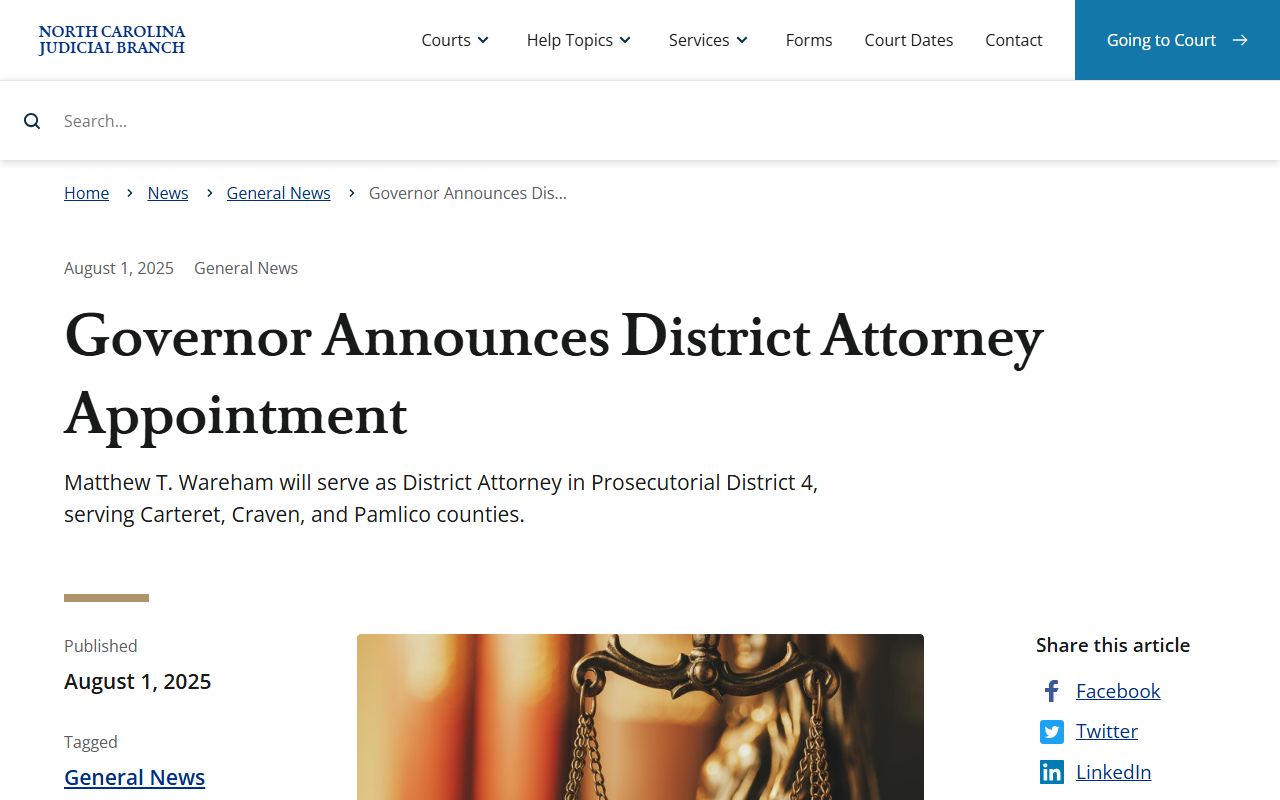
The prosecutor's role matters because charging decisions and trial dockets affect what appears in a Carteret County criminal court record.
Search Carteret Criminal Records
Criminal court records are searched online through the North Carolina eCourts Portal. Smart Search is the main case-information tool. Search Hearings is used for hearing dates. Make Payments can search eligible criminal or infraction payments by citation number, case number, party name, business name, or driver's license. For an official background check, Judicial Branch guidance points users to the county clerk's office rather than relying only on Portal.
- Open eCourts Smart Search and select Carteret County when filtering by location.
- Search by defendant name, case number, record number, or other available criminal case field.
- Use advanced filters such as case type, case status, filing date, date of birth, or party details when needed.
- Open the public case information to review charges, events, hearings, disposition, and sentence-related entries.
- Contact the Carteret Criminal Division for certified copies, older paper files, background-check procedures, or restricted-record questions.
Public self-service terminals at clerk offices can also access criminal case information by defendant name, case number, or victim or witness name. Paper files are viewed in the county where the case is located, so a Carteret criminal paper file is handled through the Carteret Clerk of Superior Court.
Carteret Criminal Case Flow
A criminal court record grows as the case moves. A new charge can appear before the final outcome is known. Later entries may show arraignment, counsel, motions, continuances, plea negotiations, trial events, dismissal, conviction, sentencing, probation, restitution, costs, or appeal notices. The same case may contain several counts with different outcomes.
Case flow: Charges Filed › Arraignment › Pretrial and Motions › Plea or Trial › Disposition › Sentencing
| Stage | What Happens |
|---|---|
| Charges filed | The allegation enters the court record by citation, warrant, complaint, information, indictment, or other charging process. |
| Arraignment | The defendant is informed of the charge, counsel issues are addressed, and a plea may be entered. |
| Pretrial and motions | The case may show discovery disputes, continuances, bond review, suppression motions, or scheduling orders. |
| Plea or trial | The charge may be resolved by plea, bench trial, jury trial, dismissal, or other disposition. |
| Disposition | The record states the outcome for each charge, such as guilty, dismissed, not guilty, or responsible. |
| Sentencing | The court enters jail or prison time, probation, fines, costs, restitution, or other conditions after conviction. |
Carteret Criminal Record Fields
Criminal case records should be read field by field. A single Carteret County criminal court record may include multiple charges, and each charge can have its own status or disposition. The docket may also include financial entries. Court costs, fines, restitution, attorney fees, probation fees, and payment eligibility may appear when public and applicable.
| Field | What It Shows |
|---|---|
| Case number | The court identifier for the criminal case or citation-linked matter. |
| Defendant | The person charged, with available party details and identifiers when public. |
| Court division | District Court, Superior Court, magistrate-related event, or Carteret County location. |
| Charges | Offense name, statute, count, level, filing date, and any amended or dismissed charge. |
| Hearings | Arraignments, motions, pleas, trials, sentencing, probation, or review dates. |
| Plea | The defendant's formal answer, such as guilty, not guilty, or other plea entry. |
| Disposition | The outcome for a charge, including conviction, dismissal, acquittal, or responsibility finding. |
| Sentence | Jail or prison, probation, fines, costs, restitution, conditions, and payment obligations. |
| Restrictions | Sealed, expunged, juvenile, confidential, or redacted material that is not displayed publicly. |
Charges vs Convictions
A charge is an accusation filed with the court. A conviction is an outcome after a guilty plea, verdict, or other judgment of guilt. Carteret County criminal court records can show charges that are pending, amended, reduced, dismissed, or resolved without a conviction. This is why a name match or charge entry should not be read as proof of guilt.
| Point | Charge | Conviction |
|---|---|---|
| Meaning | An allegation filed in court. | A final finding or plea of guilt. |
| Record stage | Can appear early in the case. | Appears after plea, trial, or judgment. |
| Outcome | May be dismissed, amended, or reduced. | May lead to sentence, probation, fines, or costs. |
| Use caution | Does not prove guilt. | Still may be appealed, corrected, or later expunged if eligible. |
Sealed vs Expunged
Restricted criminal court records require careful handling. Juvenile delinquency and undisciplined records are maintained by the clerk but are not ordinary public files. Criminal investigation records held by law enforcement may be restricted under G.S. 132-1.4. Expunction rules can remove public entries for eligible arrests, charges, or convictions.
The G.S. 15A-153 expunction effect statute explains the public-record effect of an expunged Carteret County criminal court record.
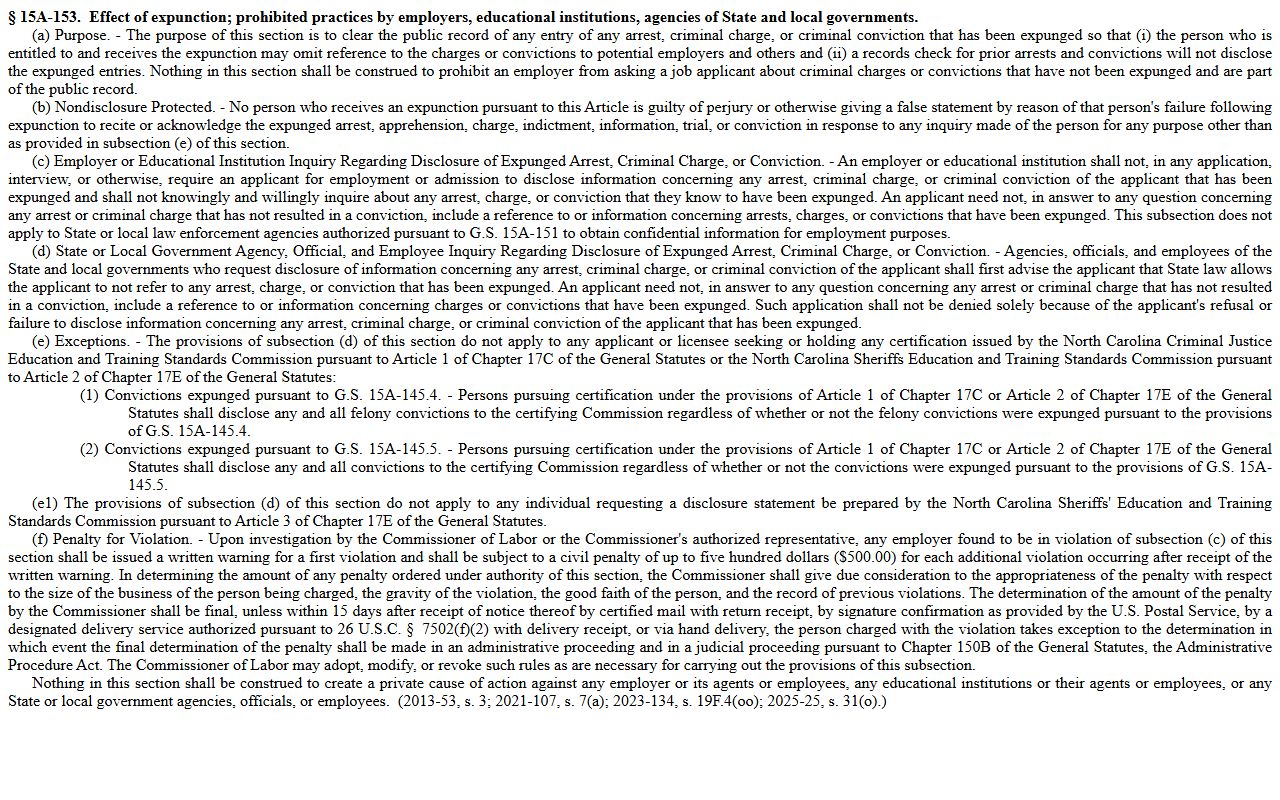
The statute is relevant because an expunged Carteret criminal matter may no longer appear in ordinary public court-record checks.
| Point | Sealed Record | Expunged Record |
|---|---|---|
| Public visibility | Hidden from ordinary public inspection by law or court order. | Public entries are cleared for eligible matters after an expunction order. |
| Record status | The file exists but access is limited. | The public record is treated as removed under the expunction statute. |
| Examples | Juvenile, adoption, mental-health, protected information, or sealed filings. | Eligible dismissed charges or eligible older convictions under specific statutes. |
| Where to ask | Clerk or court order, depending on party status. | Clerk, AOC forms, and the court where the case occurred. |
Carteret Criminal Access Limits
North Carolina law supports access to many court records, but it does not make every criminal-related record public. G.S. 7A-109 is the court-record statute requiring clerks to maintain records and keep them open to public inspection unless another law restricts them. G.S. 132-1 defines public records broadly, but law-enforcement investigative files have separate limits.
For Carteret County, access channels should be separated. eCourts handles public case search and hearing search. Public terminals at clerk offices handle criminal case information. Paper files and certified copies go through the Carteret Clerk of Superior Court. Sheriff's arrest reports, booking records, and warrant-service records go to the Sheriff's Office or the related law-enforcement agency. State prison, probation, and parole history is searched through NC Department of Adult Correction, not the county court file.
Note: A Carteret County criminal court record can show a public case without opening every police report or investigation file.
Criminal Background Checks
Casual case lookup and a formal background check are not the same task. Portal can help locate Carteret County criminal court records, but the Judicial Branch says people performing background checks should use the county clerk's office. A clerk search can be more reliable for official criminal case information, certified copies, and older or paper-based records. It also helps avoid mistaking a same-name match for the correct person.
For custody status, use the jail or NC VINE channel. For state prison, probation, or parole history, use NC DAC. For sex-offender registration, use the North Carolina Sex Offender Registry and Carteret Sheriff's registration office. These systems may relate to a criminal case, but they are not substitutes for the Carteret criminal court record.
Restricted Criminal Records
Some Carteret County criminal court records are missing from public search for valid legal reasons. Juvenile cases, sealed filings, mental-health information, confidential victim or witness information, protected addresses, Social Security numbers, financial account numbers, and expunged matters may be withheld or redacted. A public docket may still show limited activity while the sensitive document is hidden.
When a criminal record appears incomplete, use the clerk's office rather than guessing. The Criminal Division can explain whether a public file exists, whether a copy request is available, and whether the issue belongs with the Sheriff's Office, District Attorney, Public Defender, NC DAC, or another agency.