
Carteret Court Record Sources
Carteret County court records are maintained by the Carteret County Clerk of Superior Court, a North Carolina Judicial Branch office that keeps both Superior Court and District Court files. Carteret is an eCourts county, so the main online starting point is the North Carolina eCourts Portal. Smart Search is used for public case information, Search Hearings is used for court dates, and Make Payments is used for eligible criminal and infraction payments.
Online search is only one channel. The Judicial Branch says public self-service terminals at clerk offices can show criminal, civil, special proceeding, and estates case information. Actual paper files are viewed in the county where the case is located, so Carteret paper files are handled through the clerk in Beaufort. Staff can provide copies for a fee, and certified copies should come from the clerk rather than a screen print from Portal.
The eCourts Portal home is the official statewide entry point for Carteret County court records online.
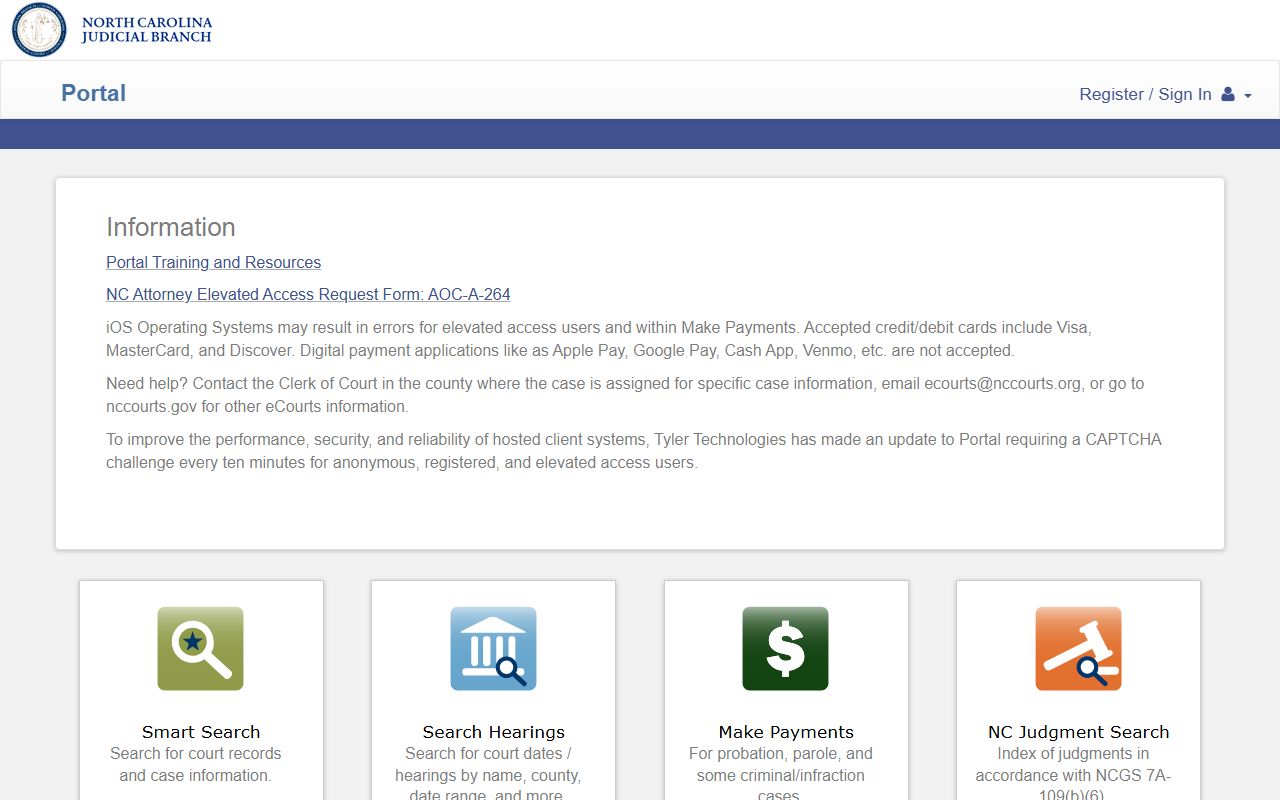
The portal view matters because Carteret County court records now sit inside the same statewide eCourts system used for case search, hearings, payments, and judgments.
- Open the eCourts Portal and choose Smart Search for Carteret County court records.
- Select Carteret County under the location filter when the search is not already narrowed to the county.
- Search by case number, record number, party name, business name, or another available field.
- Use the posted name format and wildcard rules, because short partial names may fail.
- For certified copies, sealed files, older paper files, or background checks, contact the Carteret Clerk of Superior Court.
Carteret Court Search Fields
Smart Search accepts broad and advanced Carteret County court records searches. The research capture did not expose a complete public sample case, but it did capture the fields and format notes. Portal users should enable JavaScript and cookies. The system also uses periodic CAPTCHA checks for anonymous, registered, and elevated-access users, and Portal help points users back to the clerk in the county where the case is assigned.
| Field Label | Type | Required | Notes / Format |
|---|---|---|---|
| Record Number or Name | Text | Conditional | Use a case number or Last, First Middle Suffix format. |
| Last Name / First Name | Text | Conditional | Name wildcard searches need enough letters and an asterisk. |
| Middle Name / Suffix | Text / dropdown | Optional | Suffix must match a valid portal option. |
| Filter by Location | Dropdown | Optional | Select Carteret County to avoid statewide noise. |
| Search Type | Dropdown | Optional | Includes party, nickname, business name, and sounds-like options. |
| Date of Birth From / To | Date | Optional | Useful for narrowing common names. |
| Case Type / Case Status | Dropdown | Optional | Labels vary by Portal category and case data. |
| File Date Start / End | Date | Optional | Limits results to a filing-date range. |
| Booking, FBI, or SO Number | Text | Optional | Party filters may appear for criminal-related records. |
Carteret Court Record Types
Carteret County court records come from the Superior Court and District Court divisions of the North Carolina General Court of Justice, with magistrates and the Clerk of Superior Court handling some early or specialized functions. Superior Court handles felony prosecutions, larger civil cases, and appeals from District Court. District Court handles misdemeanors, infractions, traffic matters, many family cases, juvenile matters, small civil cases, and magistrate functions.
The Judicial Branch court-record guidance separates court files from other county records. Police reports come from the investigating agency. Birth, death, marriage, deeds, and many land records go to the Register of Deeds. General county administrative records go through the county request route, but that route specifically sends court records back to the clerk.
The Judicial Branch obtaining court records guide is the statewide source for viewing and copying court files.
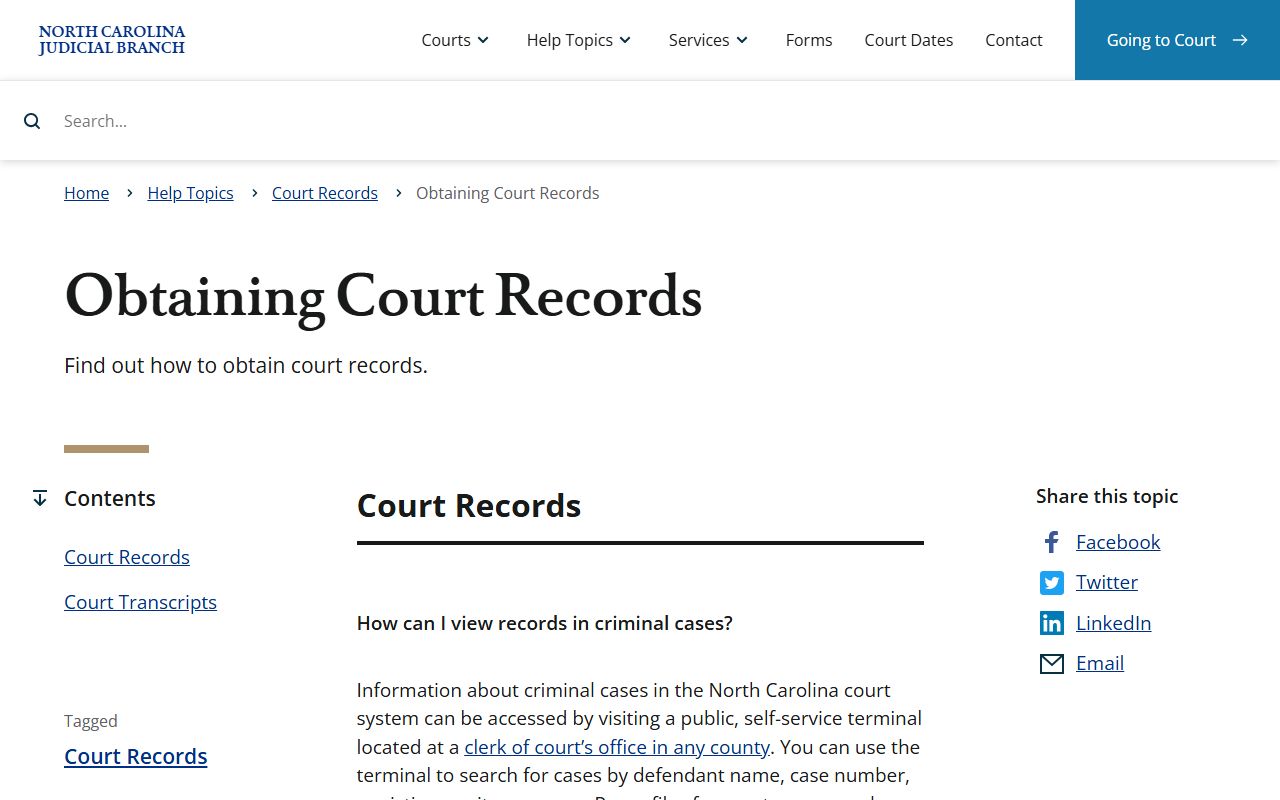
The guide is important for Carteret County court records because it confirms the split between online information, public terminals, paper files, and agency records outside the clerk's custody.
- Civil files may include complaints, summonses, motions, orders, judgments, liens, appeals, and satisfaction entries.
- Criminal files may include charges, pleas, hearings, dispositions, sentences, costs, probation terms, and bond events.
- Family and divorce files may include judgments, custody orders, support matters, and restricted child-related material.
- Probate and estate files are handled by the Clerk of Superior Court acting as probate judge.
- Traffic and infraction cases are state court files, separate from NCDMV driver records.
Carteret Case Record Fields
A Carteret County case record is not always a scanned file. Public search data may show the index, case status, parties, court events, and financial items, while documents can be limited by access level or require a clerk copy. Background checks should be handled through the clerk's office, not by assuming that Portal results are a full criminal-history report.
| Field | What It Shows |
|---|---|
| Case or record number | The unique court identifier, such as a criminal case number or citation-linked record. |
| Court and location | Carteret County, Superior Court, District Court, magistrate, estates, or other case location. |
| Case type and status | Whether the file is civil, criminal, traffic, estate, special proceeding, open, disposed, dismissed, appealed, or restricted. |
| Parties and attorneys | Names of plaintiffs, defendants, petitioners, respondents, state parties, and attorneys where public. |
| Dates | Filing dates, hearing dates, judgment dates, offense or citation dates, and payment due dates. |
| Docket events | Filings, motions, orders, service entries, continuances, pleas, sentencing, or notices of appeal. |
| Financial fields | Costs, fines, restitution, payment eligibility, and other money entries when public. |
| Redactions | Missing or hidden data may reflect sealed, juvenile, expunged, financial, or confidential law-enforcement limits. |
Carteret Court Access Law
North Carolina public-access rules start with the broad public-records definition in G.S. 132-1 and the general inspection framework in Chapter 132. Court records also have a court-specific rule: G.S. 7A-109 requires clerks to keep court records and, unless law provides otherwise, keep them open for public inspection during regular office hours.
The G.S. 132-1 public-records statute is one of the key access sources for Carteret County court records and related government records.
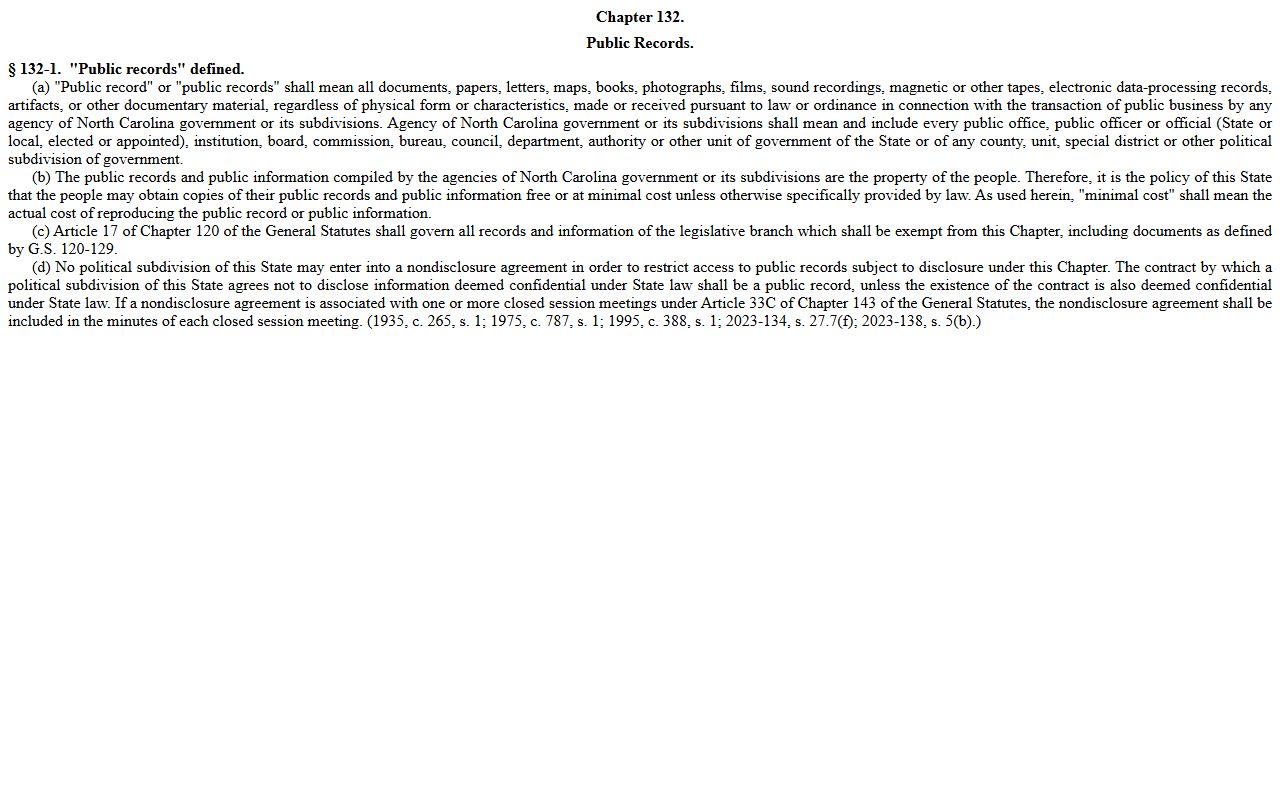
That statute supports broad access, but Carteret court users still need the court-specific clerk route for case files and certified copies.
County routing matters. The Carteret County public-records request page says court records, court dates, and hours of operation should go to the Clerk of Court at (252) 504-4400. Law-enforcement records go to the Sheriff's Office or the related agency, and vital records go to the Register of Deeds. Sending a court-file request through the wrong county form can slow the answer.
Note: Portal access is useful for public case data, but certified Carteret County court records come from the clerk.
Restricted Carteret Court Records
Not all Carteret County court records are public. Juvenile delinquency and undisciplined records are kept by the clerk under G.S. 7B-3000, but they are not ordinary public case files. Abuse, neglect, dependency, adoption, mental-health, and protected-person records may be confidential or available only by court order.
Criminal investigation and intelligence records are different from court case records. G.S. 132-1.4 restricts many law-enforcement investigation materials, so a public criminal case may exist even when the full police report is not open. Expunctions also affect public access. Under G.S. 15A-153, an expunction is meant to clear public entries for eligible arrests, charges, or convictions.
Restricted access can also appear as redaction rather than a fully hidden file. A Carteret County court record may show the case number and next hearing but omit a protected address, financial account number, minor's name, medical detail, or confidential victim information. That distinction matters when a docket looks incomplete. The missing field may be withheld by law even when the case itself remains public.
The North Carolina Chapter 132 public-records index shows the broader public-records framework that sits beside court-specific rules.
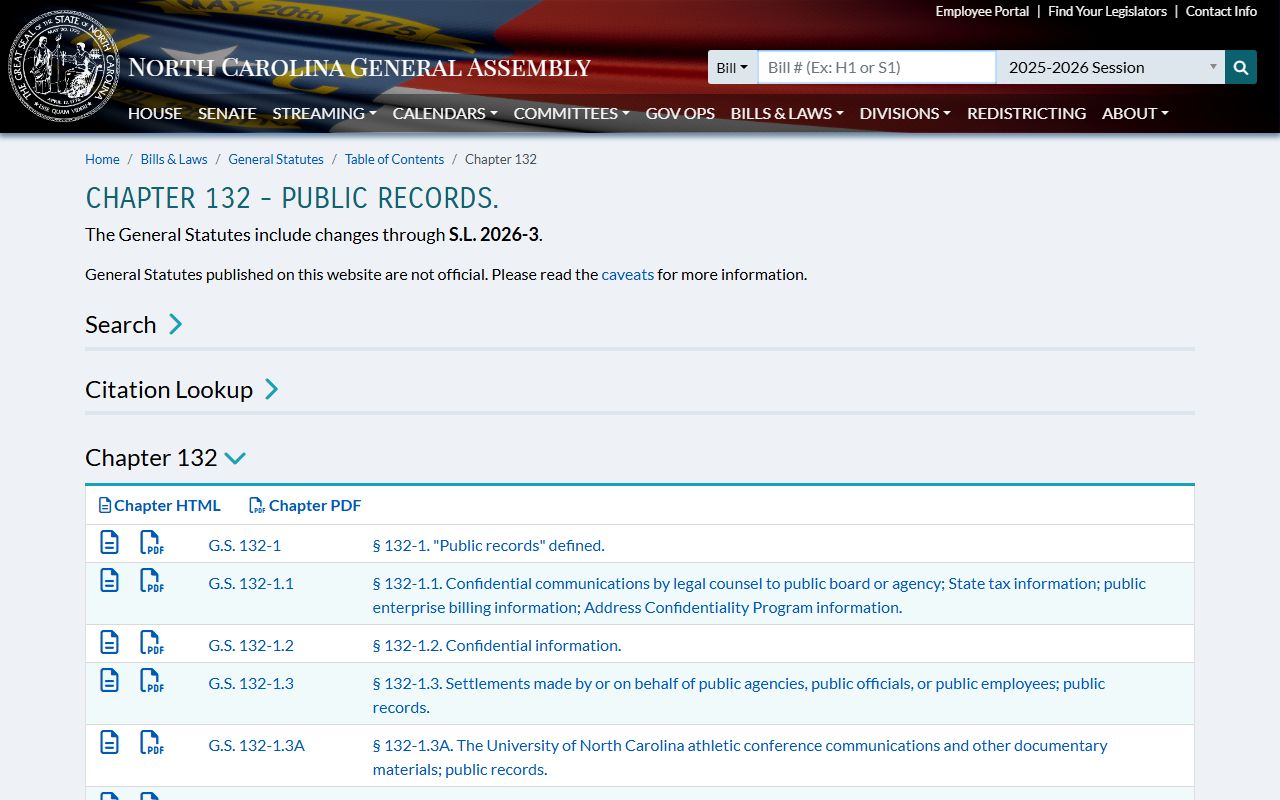
For Carteret County court records, Chapter 132 helps explain access, while juvenile, expunction, law-enforcement, and court-sealing rules explain why some entries are missing.
Carteret Clerk Record Requests
In-person Carteret County court records access runs through the Clerk of Superior Court at the courthouse. The clerk's office can route civil, criminal, estates, special proceedings, juvenile, bookkeeping, cashier, and copy questions. The research lists direct lines for Civil at (252) 504-4422, Criminal at (252) 504-4444, Estates at (252) 504-4455, Special Proceedings/Juvenile at (252) 504-4466, and Bookkeeping/Cashiers at (252) 504-4411.
Payment and copy details depend on the transaction. Carteret payment guidance says mail payments use money order or certified check only, with no cash and no personal checks by mail. In-person cashier payments may use cash, credit or debit card with processing fees, money order, or certified check, but no personal checks. For records rather than payments, ask the clerk whether a plain copy or certified copy is needed.
A requester should bring enough information to identify the court record: party names, approximate filing date, case number, citation number, estate name, or hearing date. For common names, date of birth or another lawful identifier may help the clerk locate the correct file. If the goal is legal proof, ask for a certified copy before leaving the office.
Clerk of Superior Court
300 Courthouse Square
Beaufort, NC 28516
(252) 504-4400
Monday-Friday, 8:30 a.m.-5:00 p.m.
Carteret County court records should not be requested from the Register of Deeds unless the need is for a separate land, marriage, birth, death, notary, assumed-name, or military-discharge record. Court records and divorce judgments are clerk records; Sheriff's arrest, booking, incident, and warrant-service records are law-enforcement records.